First Aid
Choking First Aid: How to Perform the Heimlich Manoeuvre
By First Aid Kit Spot Editorial Team • Published 2026-01-01
This post contains affiliate links. We may earn a commission at no extra cost to you.
IMPORTANT: This guide is for educational purposes. Always call emergency services (000 in Australia, 999 in UK, 911 in USA) when someone is choking severely. First aid knowledge supplements -- but does not replace -- professional emergency care.
By Sarah Mitchell, First Aid Instructor | Last updated March 2026
Choking kills approximately 4,500 people annually in Australia and the UK combined. The vast majority of choking deaths are preventable with prompt, correct first aid. Knowing how to perform the Heimlich manoeuvre (abdominal thrusts) and the correct infant technique could save a life -- possibly today. This guide provides the complete, evidence-based protocol.

Table of Contents
- Recognising Severe Choking
- Heimlich Manoeuvre: Step-by-Step for Adults
- Choking First Aid for Children
- Choking First Aid for Infants Under 12 Months
- What to Do if You Are Choking Alone
- After the Object Is Expelled
- Essential First Aid Products
- Preventing Choking at Home
- Frequently Asked Questions
- Sources & Methodology
Recognising Severe Choking {#recognising-choking}
The most important skill is recognising when intervention is needed.
Signs of SEVERE choking (complete obstruction -- ACT IMMEDIATELY):
- Cannot speak or make sound, or only making high-pitched stridor sounds
- Cannot cough effectively
- Cannot breathe or extremely laboured breathing
- Face turning red, then blue/pale (cyanosis)
- Clutching throat with one or both hands (universal choking sign)
- Losing consciousness
Signs of MILD choking (partial obstruction -- encourage coughing):
- Can still speak (even if hoarse)
- Can cough forcefully
- Can breathe, even if with difficulty
For mild choking: Encourage the person to cough hard and repeatedly. Stay with them. Do not perform abdominal thrusts -- this can turn a partial obstruction into a complete one or cause injury. If their ability to cough deteriorates, immediately move to severe choking protocol.
Heimlich Manoeuvre: Adults and Children Over 1 Year {#adults}
Step 1: Call for Help
Call emergency services (000/999/911) immediately or have someone else call while you assist. If alone, call before starting if possible -- leave the line open.
Step 2: Position Yourself
Stand behind the choking person. Ask them to stand if seated and able. Place one leg forward between their feet for stability.
Step 3: Give 5 Back Blows
With the heel of your hand, give 5 firm back blows between the shoulder blades. This is recommended by current Australian Resuscitation Council guidelines as the first step before abdominal thrusts.
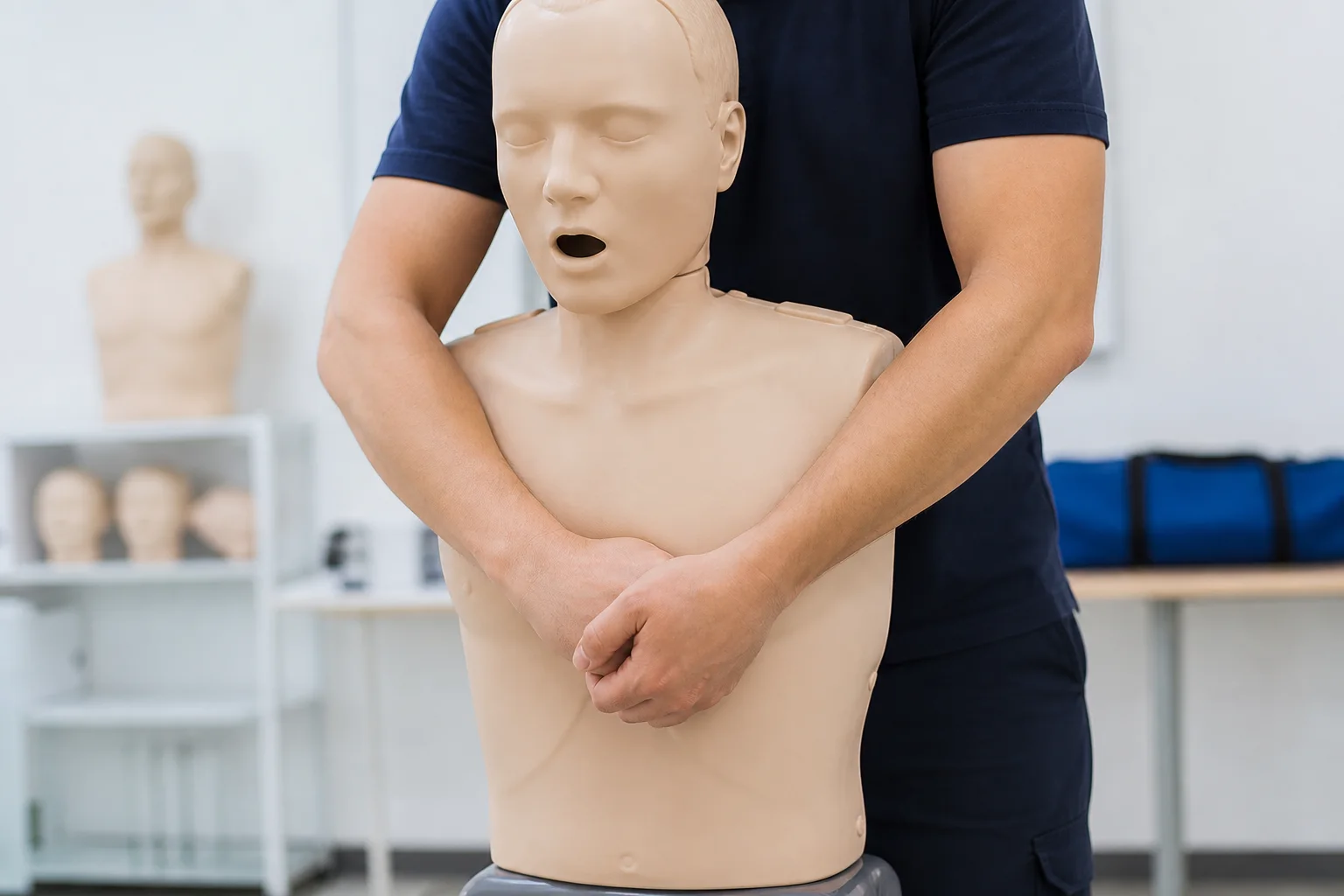
Step 4: Abdominal Thrust Position
Wrap your arms around the person's waist from behind. Make a fist with one hand. Place the thumb side of your fist against the abdomen:
- Above the navel (belly button)
- Below the breastbone (xiphoid process)
Cover your fist with your other hand.
Step 5: Upward Thrusts
Deliver 5 firm, upward thrusts into the abdomen. Each thrust should be a separate movement -- not one continuous push. The motion is inward and upward, aimed at forcing air out of the lungs to expel the obstruction.
Step 6: Repeat Until Resolved
Alternate 5 back blows and 5 abdominal thrusts until:
- The object is expelled
- The person can breathe and cough effectively
- The person loses consciousness (see below)
If the Person Loses Consciousness
Lower them to the ground carefully. Begin CPR immediately. Each time you open the airway to deliver rescue breaths, look in the mouth -- if you can see the object, remove it. Do not perform blind finger sweeps.
Choking First Aid for Children 1-8 Years {#children}
The technique is the same as for adults but with reduced force:
- Use one hand for back blows (rather than heel-of-hand force)
- Abdominal thrusts with one hand only, adjusted for the child's size
- Kneel or crouch to be at the child's level
The thrust force should be appropriate to the child's body size -- firm but not adult-force.
Choking First Aid for Infants Under 12 Months {#infants}
DO NOT use abdominal thrusts on infants under 12 months. The liver and abdominal organs are at significant risk of injury. The technique is different:
Back Blows (Infant)
- Hold the infant face-down on your forearm, supporting the head in your hand (lower than the body)
- Deliver 5 firm back blows with the heel of your hand between the shoulder blades
- Each blow should be a separate strike, not a continuous push
Chest Thrusts (Infant)
- Turn the infant face-up on your other forearm, supporting the head
- Place 2 fingers on the lower half of the breastbone, just below the nipple line
- Deliver 5 firm downward chest thrusts (similar to CPR chest compressions but slightly deeper)
- Check mouth after each cycle -- if you can see the object, carefully remove it
Repeat Alternating Cycles
Continue alternating 5 back blows and 5 chest thrusts until the object is expelled or emergency services arrive. Never leave an infant alone while they are choking.
For more information about protecting children from choking hazards, see our guide on baby choking prevention which covers safe food introduction and hazard identification for infants.
If You Are Choking Alone {#alone}
If you are alone and choking and cannot call for help:
Method 1 -- Self-abdominal thrusts: Make a fist, place it thumb-side on your abdomen (above navel, below breastbone), cover with your other hand, and deliver 5 firm upward thrusts.
Method 2 -- Chair/counter edge: Find a solid edge (back of a sturdy chair, kitchen counter). Lean over the edge so it contacts your upper abdomen. Thrust your upper body down forcefully so the edge delivers the upward abdominal compression.
Call first if possible: Even if you cannot speak, calling emergency services and leaving the line open helps dispatchers locate you. Tapping or any audible sound communicates that you need help.
Essential First Aid Products {#products}
LifeVac Anti-Choking Device
Best for: Suction-based airway clearance
Use when: Heimlich fails or not possible
Check on Amazon
Dechoker Anti-Choking Device
Best for: Homes with young children or elderly
Use when: Cannot perform Heimlich
Check on Amazon
Primedic CPR Face Shield
Best for: Post-choking CPR if needed
Includes: One-way valve, gloves
Check on Amazon
St John First Aid Handbook
Best for: Comprehensive reference guide
Covers: All emergency scenarios
Check on Amazon
First Aid Only Complete First Aid Kit
Best for: Home emergency preparedness
Includes: 299 pieces, guide included
Check on AmazonFrequently Asked Questions {#faq}
How do you perform the Heimlich manoeuvre? Stand behind person, wrap arms around waist, fist above navel below breastbone, cover with other hand, give 5 upward thrusts. Alternate with 5 back blows. Repeat.
What do you do for a choking infant? Face-down back blows (5) then face-up chest thrusts (2 fingers, 5). Alternate. No abdominal thrusts for under 12 months.
When should you do back blows vs abdominal thrusts? Alternate both for adults and children over 1 year: 5 back blows, then 5 abdominal thrusts. Back blows only for infants combined with chest thrusts.
What if you're choking alone? Self-abdominal thrusts or lean over a chair/counter edge for compression. Call emergency services first.
Sources & Methodology {#sources}
- Australian Resuscitation Council. (2021). Guideline 7.1 -- Management of Foreign Body Airway Obstruction.
- American Heart Association. (2020). Choking: Adult/Child and Infant.
- British Red Cross. First Aid Manual -- Choking. 10th Edition.
- Heimlich HR (1975). A life-saving maneuver to prevent food-choking. JAMA, 234(4).
- Sternbach G (1997). The history of Heimlich's maneuver. Journal of Emergency Medicine, 15(3).
For related first aid skills, see our guides on what every first aid kit should contain, CPR guide for adults, and best first aid kits for home.
Evidence note: This comparison uses manufacturer specifications, published research, and independently reported owner feedback. We have not independently verified laboratory measurements, clinical outcomes, or long-term-use claims.
Preventing Choking at Home {#prevention}
Prevention reduces the frequency of choking emergencies:
High-Risk Foods for Young Children
Children under 4 have smaller airways and incomplete chewing skills. High-risk foods include:
- Round foods: grapes (must be quartered), cherry tomatoes, hard candy, small fruits
- Hard raw vegetables: whole carrots, celery sticks
- Tough meat: steak, chops not cut small
- Nuts and seeds
- Popcorn
- Hot dogs (must be cut lengthwise then into small pieces)
Preparation rules: Cut food into pieces no larger than 1.5cm (half-inch). Cut round foods (grapes, cherry tomatoes) into quarters or halves. Avoid round hard foods until age 4.
Safe Eating Habits
Regardless of age:
- Sit upright while eating (not reclined or lying down)
- Eat slowly and chew thoroughly
- Avoid talking while chewing or swallowing large pieces
- Avoid distracted eating (screens, phone, rushing)
- Supervise children while eating -- particularly for high-risk foods
For Elderly Adults
Swallowing disorders (dysphagia) are more common in older adults, particularly after stroke or with neurological conditions. Signs include coughing after eating or drinking, slow or effortful swallowing, or food remaining in the mouth after swallowing. Speak with a speech pathologist if swallowing difficulties are present.
After a Choking Incident {#aftermath}
Even when choking is resolved by first aid, follow-up steps matter:
If abdominal thrusts were performed: The force can cause bruising or rarely internal injury. Seek medical evaluation after any choking incident requiring Heimlich manoeuvre.
Partial object expulsion: If the object was partially expelled but remains in the airway (the person is still experiencing difficulty breathing after the apparent resolution), seek emergency care immediately.
Emotional support: Choking is a traumatic experience for both the victim and bystanders. Acknowledge this and allow time for recovery and debrief.
Practice: After a choking event, consider enrolling in a formal first aid course to build confidence and ensure correct technique for future situations.
Good first aid starts with having the right tools on hand. See our first aid kit checklist to ensure your home kit has everything needed for choking emergencies and other common situations.